Why Staffing Numbers Don’t Prove Causation
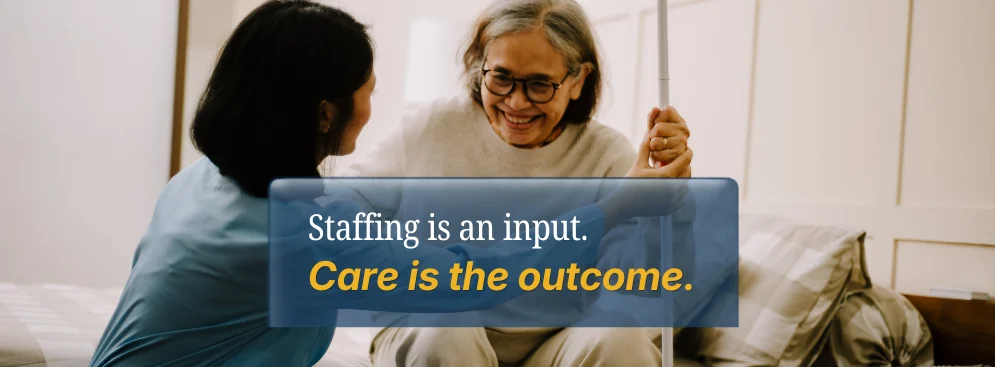
In long-term care litigation, the staffing schedule has become one of the plaintiff’s favorite exhibits. Blow up the roster. Circle an open slot on the night shift. Let jurors connect the dots: fewer hands, so the fall was inevitable. So someone is to blame.
It’s a compelling story. It’s also a shortcut. A staffing level describes a building. It doesn’t explain what happened to a resident.
The question that matters isn’t “Were there enough people in the building?” It’s “Did anything the staff did, or didn’t do, cause this harm?” Here’s how the defense keeps jurors focused on that question.
1. Move the case from the roster to the bedside. Staffing arguments live at the facility level. Causation lives at the bedside. Walk jurors through the actual shift. A resident with advanced dementia stands up unassisted at 2:10 a.m., between documented two-hour checks. Bed in its lowest position. Call light in reach. Nonskid socks on. One more aide on the floor would not have been standing at that bedside at 2:10. Make the plaintiff explain the mechanism, not the math.
2. Show the care that happened. Jurors picture an empty hallway. Show them the full one: repositioning charted at midnight and 2 a.m., meal intake recorded, a family call returned before shift change. Name the charge nurse who stayed through a double to cover a call-out. Name the CNA who noticed a change in breathing and escalated within minutes. Documentation turns a “short” shift into a shift where care was delivered.
3. Put the numbers in context. Staffing expectations vary by state, and the regulatory picture has shifted in recent years, so “below standard” is often a contested phrase rather than a fact. The workforce shortage in long-term care is real, and facilities didn’t create it. Show what yours did about it: recruiting efforts, agency contracts, overtime offered, cross-training. That’s not neglect. That’s a provider working a hard problem. [Verify: any national staffing or workforce figure added here needs a cited source.]
4. Separate frailty from staffing. Many outcomes plaintiffs tie to understaffing, such as pressure injuries, weight loss, and falls, also flow from disease progression, comorbidities, and resident choice. A pressure injury can develop on a resident with poor circulation and end-stage illness even with on-time turning. Your experts should tie the outcome to the clinical picture, not the schedule.
Staffing is a fair topic for a policy debate. In a courtroom, it is not a substitute for proof.
A thin schedule tells you how many people were working. It doesn’t tell you that anyone failed.
For more insights on defending long-term care providers, read Aging, Accusations, and Accountability by John E. Hall, Jr., Esq., available on Amazon.